Field Guide · Nº 03
Tarrytown & Clarksville
Historic West Austin — lake access, legacy oaks, and the shortest luxury commute in the city.
← All neighborhood guides Downtown & Central Austin · Updated

Or one neighborhood at a time: Old Enfield · Clarksville & Old West Austin · Tarrytown
The feel of Tarrytown & Clarksville
West of MoPac and south of 35th Street, Tarrytown has been one of Austin’s most established neighborhoods for a century, and it wears that history lightly. The streets bend around live oaks that predate the houses; the houses run from 1930s brick traditionals to new limestone-and-steel builds; and the rhythm of life is organized around a handful of institutions — Deep Eddy Pool (the oldest swimming pool in Texas), Lions Municipal Golf Course, Mayfield Park with its resident peacocks, and the little Tarrytown shopping center on Exposition where errands still feel like a small town.
Clarksville, tucked between MoPac and downtown, is the more compact, more walkable counterpart. Founded in 1871, it is one of the oldest neighborhoods in Austin, protected by a National Register historic district, and its narrow streets mix restored cottages with some of the city’s best restaurants — Jeffrey’s and Josephine House sit on a residential corner, and Fresh Plus grocery has anchored West Lynn for generations.
Who does this pair suit? Buyers who want central Austin permanence: proximity to downtown, top-tier public schools, lake access, and streets that will look substantially the same in thirty years. It appeals to buyers moving up for the Casis attendance zone and to buyers who want a real yard ten minutes from the office. It may be less of a fit for buyers who are price-sensitive, who want new construction on a big flat lot, or who’d rather not compete in a market where the best homes often trade quietly.
Schools
The feeder pattern is the strongest in Austin ISD: Casis Elementary, O. Henry Middle School, and Austin High. Casis, on Exposition Boulevard, is genuinely a driver of home values here — buyers pay a premium specifically for the attendance zone, and have for decades. Austin High’s lakeside campus is a short drive or bike ride away.
The honest picture: this is AISD at its best, but it is still a large urban district with budget pressures, and O. Henry draws from a wider zone than Casis. Several of Austin’s most established private schools are also within a short drive if you’re weighing options from middle school onward. As always, we verify the current attendance zone for a specific address before you rely on it — boundaries can and do shift.
The commute
This is the neighborhood’s ace. Downtown is 5–10 minutes via Enfield Road or Lake Austin Boulevard — close enough that lunch at home is realistic. The Capitol complex and UT are similarly quick. MoPac runs along the eastern edge, which cuts both ways: fast access north and south, but traffic noise on the blocks nearest the highway — walk any property near MoPac at rush hour before you buy.
Heading north to the tech corridor, figure 20–25 minutes to the Domain via MoPac in normal conditions, more at peak. The airport runs 20–30 minutes. If your life is oriented west toward Eanes schools instead, compare with Westlake across the river — the price bands overlap considerably.
Property taxes and the teardown dynamic
Effective property tax rates run roughly 1.8–2.0% of market value — City of Austin, Travis County, Austin ISD, Central Health, no MUDs. On a $2M property that is real money annually, so model it carefully; Texas has no income tax, but it collects at the courthouse.
The structural story of Tarrytown for twenty years has been teardown-rebuild. Original 1940s–1960s homes on quarter-acre lots are routinely purchased for land value, and new construction in the $3M–$6M range replaces them. That dynamic supports values but changes blocks — if you buy a charming original home, expect construction next door at some point. In Clarksville, the National Register historic district and local preservation rules constrain demolition and exterior changes on contributing structures, which is exactly why the streetscape has survived; budget time for design review if you plan to renovate there. We help clients understand, lot by lot, whether a property’s value is in the structure or the dirt — it changes the negotiation entirely.
What you’ll find
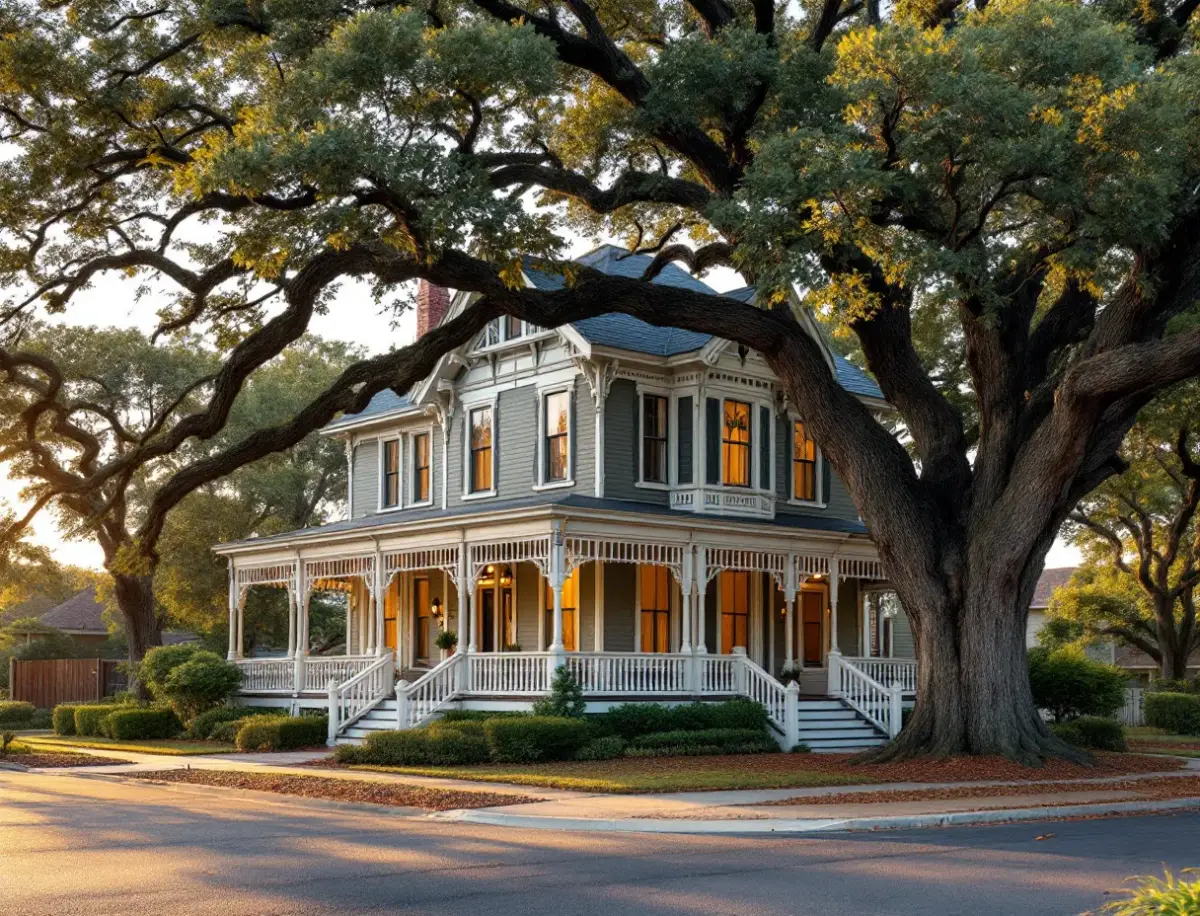
Tarrytown’s homes span 1930s brick and white-painted traditionals, midcentury ranches, 1980s–1990s remodels, and a steady supply of new custom builds — limestone, stucco, and the modern farmhouse style now common across West Austin. Lots typically run 0.2 to 0.4 acres, larger near the lake. Clarksville is cottages and bungalows on small lots, plus a meaningful condo and townhome layer that provides the area’s most accessible entry point.
Per Redfin and Zillow public market data as of July 2026, Tarrytown’s median sale price sits around $1.5M–$1.6M, with originals from roughly $900K–$1.3M and new or fully renovated homes commonly $2.5M–$4M+; Clarksville sells in a wide band — condos from the $500Ks–$700Ks, houses generally $900K–$2M+ — verify current, since low transaction counts make these medians swing. Buyers who love the walkable-historic feel at a lower price point should also look at Hyde Park east of campus; buyers prioritizing parks and the greenbelt lifestyle often cross-shop Zilker and Barton Hills south of the river.
For owners
Own a home in Tarrytown & Clarksville?
If you are keeping it rather than selling, we manage homes here: broker-run, every repair invoiced at cost, and a written record of every system in the house. Long-term leases only.
- Median leased rent at $3,500 a month and above
- $6,000 a month
- Median days to lease
- 23
58 closed leases in Tarrytown & Clarksville, 180 days ending Nov 23, 2026, 10:09 AM CST. Source: Unlock MLS as distributed by MLS GRID. Every neighborhood →
The local's list
What we tell clients once they've moved inGreen space & trails
- Deep Eddy Pool — the oldest swimming pool in Texas, spring-fed and unheated; the year-round lap swimmers are their own subculture
- Mayfield Park — peacocks roaming the cottage gardens, with quiet trails through the adjoining preserve toward Lake Austin
- Walsh Boat Landing — the neighborhood's Lake Austin put-in; weekday mornings mean calm water, weekend afternoons a boat parade
- Lions Municipal Golf Course — the 1924 muni everyone calls Muny; weekday tee times go when the pro shop opens
Eat & drink
- Pool Burger — the tiki-leaning burger yard next door to Deep Eddy, the post-swim ritual
- Deep Eddy Cabaret — the no-frills neighborhood beer joint on Lake Austin Boulevard since 1951
- Josephine House and Jeffrey's — sister restaurants sharing a Clarksville corner; Josephine's porch at brunch is the local habit
- Fresh Plus on West Lynn — the small grocery that has kept Clarksville walkable for generations
Only-here bonuses
- The Tarrytown shopping center on Exposition — errands still work at small-town scale, and everyone runs into someone
- Clarksville's National Register streets — an evening walk doubles as a museum of restored cottages from the 1870s onward
See it in person
Walk Tarrytown & Clarksville with us
An hour on the ground tells you more than a week online. We'll show you the streets that match what you're looking for, and we'll be honest about the tradeoffs.
Prefer to talk first? Call (512) 537-8623 or email contact@raresidential.com.
Keep exploring
If you like Tarrytown & Clarksville, also look at
Westlake
Eanes schools, canyon views, and ten minutes to downtown — Austin's blue-chip address.
Zilker & Barton Hills
Barton Springs as your neighborhood pool, the greenbelt as your backyard.
Hyde Park
Austin's original suburb, where 1890s Victorians and craftsman bungalows line walkable, tree-vaulted avenues.